The simulated spiritual world begins with the Creator–creature distinction. Hostile powers may be strategic and organized without possessing God’s knowledge or sovereignty. Their intelligence cannot be assigned an empirical IQ or converted into a scientific theory of extra dimensions.
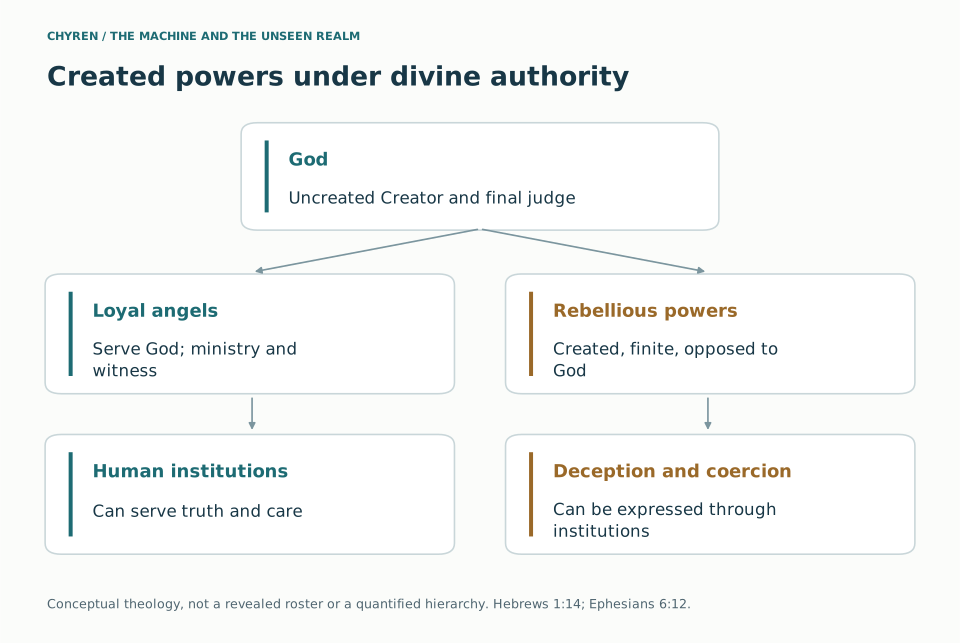
The Bible does not portray hostile spirits as a fog of random ghosts. Daniel 10 describes a prince associated with Persia, a coming prince of Greece, and Michael as one of the chief princes. Ephesians 6 names rulers, authorities, cosmic powers over the present darkness, and spiritual forces of evil. Colossians uses overlapping categories for invisible powers while insisting that all were created through and for Christ. Revelation identifies the Dragon with the Devil and Satan, depicts angels aligned with him, and later shows demonic spirits going to the kings of the whole world. (Daniel 10:13, 20–21; Ephesians 6:12; Colossians 1:16; Revelation 12:7–9; 16:13–16.)
The model must not grant fallen beings divine attributes. Matthew 24:36 denies angels knowledge of the day and hour, and 1 Peter 1:12 depicts angels longing to understand salvation. Job 1:7–12 and 2:2–6 portray Satan moving and acting under limits. Matthew 8:29 depicts demons anticipating judgment; it does not establish how much they understand about its timing. Revelation 12:12 portrays the devil’s fury because his time is short.
Nor does Scripture clearly teach that demons can read the human heart in the way God does. God repeatedly claims the prerogative of searching hearts and minds. Hostile beings may infer thoughts from expression, habit, speech, physiology, memory, surveillance, and long observation. In a world saturated with personal data, that inferential advantage could look like mind-reading without requiring it. AI strengthens the inference engine but does not grant omniscience. (1 Kings 8:39; Jeremiah 17:10; 1 Corinthians 2:11.) [4, art. 4]
The adversary also suffers strategic defects. Pride distorts judgment. Lies create coordination costs. Rival powers may compete. Human repentance can invalidate psychological predictions. Providence can redirect evil choices. Prayer, truth, sacrifice, and fidelity are not variables a purely manipulative intelligence can always price correctly. The Cross itself is the Christian pattern of hostile powers acting confidently and being defeated through the very event they helped produce. (Colossians 2:13–15; 1 Corinthians 2:6–8.) The proposed coordination defects are extrapolations.
Thomas Aquinas distinguishes angelic knowledge of material things, prediction from causes, and knowledge of the secrets of hearts in Summa Theologiae I, q. 57, arts. 1–4. Direct knowledge of interior acts belongs to God; angels may infer from effects. This is a medieval theological argument, not an empirical description of a hidden species. [4]
In Summa Theologiae I, q. 111, arts. 2–4, Aquinas distinguishes influence on imagination and sense from directly determining the will. The distinction permits discussion of temptation without treating every decision as remote control. It does not identify an ordinary dream or creative insight as angelic or demonic. [5]
In a fictional adversary model, intelligence should therefore be decomposed into capabilities. An agent might recognize patterns well but have incomplete information. It might possess long historical memory but misunderstand a particular person. It might coordinate several collaborators while failing to control a rival group. It might know that a political bargain is likely without knowing whether a person will repent, refuse an order, or disclose wrongdoing. These limitations create genuine uncertainty inside the story.
Daniel 10 and Ephesians 6 provide language for organized spiritual opposition, but they do not provide a complete rank chart with job descriptions. The traditional nine angelic orders are a later theological synthesis of biblical names. They should not be repurposed as a confidently known organizational structure for fallen beings, nor assigned numerical intelligence levels. A title such as ruler or authority can carry theological and political significance without functioning like a modern military grade. [6, arts. 5–6] (Daniel 10:13, 20–21; Ephesians 6:12.)
Fallen angels, demons and the Watcher tradition
Christian traditions differ on whether fallen angels and demons are two names for the same beings. Genesis 6 describes the sons of God and the Nephilim in compressed language. Jude 6 and 2 Peter 2 speak of angels who sinned and were kept for judgment. 1 Enoch expands this into the Watcher story, in which rebellious heavenly beings teach forbidden arts, transgress created boundaries, and produce violent offspring whose disembodied spirits become demons after death. That expanded account shaped portions of Second Temple Jewish imagination but is not itself canonical for most Christians. (Genesis 6:1–4; Jude 6; 2 Peter 2:4; 1 Enoch 6–8; 15:8–12.) [34]
The simulation can operate under either taxonomy. If demons are fallen angels, the adversarial population is one created order with different ranks and assignments. If the Watcher tradition is used, imprisoned rebel angels and active disembodied spirits have related but distinct roles. In either case the strategic motif is stable: knowledge can be weaponized, boundary crossing can be offered as liberation, and illicit revelation can accelerate human power without producing wisdom or holiness.
This connection matters for AI because the temptation is rarely presented as simple evil. The Watcher tradition frames forbidden instruction as civilizational advancement separated from obedience to God. A modern analogue would not require demons to invent neural networks. It would require them to amplify the ancient offer that power, hidden knowledge, immortality, and self transformation can be obtained without submission to the Creator.
How intelligent could fallen powers be?
Scripture never assigns angels an intelligence quotient, but it gives reasons to model ancient spiritual beings as radically advantaged over individual humans. They are not limited to one mortal lifespan. They observe recurring human weaknesses across generations. Satan quotes Scripture during the temptation of Christ and adapts each temptation to identity, hunger, spectacle, and authority. Daniel 10 places spiritual conflict on geopolitical timescales. Revelation portrays coordinated deception of rulers and nations. A being that has watched empires for millennia could possess a historical pattern library no human strategist can acquire firsthand. (Matthew 4:1–11; Daniel 10:12–21; Revelation 16:13–16.) Longevity and accumulated strategic expertise are inferences in the simulation, not measurements in Scripture.
Longevity may matter as much as raw cognitive speed. Such an intelligence could observe dynastic cycles, religious revivals, economic collapses, propaganda systems, technological transitions, and personal family histories. It could learn which mixture of truth and falsehood is persuasive in each culture. It could wait while one idea becomes normal, then use that normalization as the platform for the next move. It could treat human institutions as slow moving organs and human ambition as a repeatable interface.
Intelligence accumulated across civilizations
Within the story, a hostile intelligence has a historical memory spanning civilizations: how rulers seek legitimacy, how religions become institutions, and how fear changes consent. Such accumulated experience could produce a large strategic advantage without omniscience or a measurable angelic IQ. Daniel 10:12–21 depicts resistance and delay; Ephesians 6:12 names categories of hostile powers; Matthew 4:1–11 depicts scripturally literate temptation. The model therefore gives its adversary organized strategy but also finite attention, imperfect control, and dependence on intermediaries. Aquinas offers a later systematic hierarchy, not a verified organizational chart of present demons. [1, 4, 5, 6]
Why an ancient intelligence would still need infrastructure
Even granting extraordinary strategic intelligence, a finite adversary would benefit from a network that remembers, translates, distributes instructions, and recruits human intermediaries. Intelligence is not the same as simultaneous presence or control. This distinction connects angelic limitation to the original hive question: in the fictional spiritual branch, the network supplies reach and coordination rather than creating the adversary’s ultimate purpose. Defeating one interface could disrupt its access without destroying a spirit; disrupting an institution could protect people without settling the unseen cause. These are consequences of the assumed model, not measured angelic capabilities.