Three different projects must be distinguished: software controlling a robot; editing or developing biological tissue; and creating a humanlike digital persona. They can be combined in fiction, but success in one does not establish success in the others. Stem cell-based embryo models, organoids, and genome editing are not evidence that a complete artificial human has been manufactured or that an investigator can test whether a soul is present.
The ISSCR’s August 2025 guidelines update specifically addresses stem cell-based embryo models, calls for appropriate oversight of three-dimensional models, and reiterates restrictions on transfer into a human or animal uterus and culture to potential viability. Those recommendations describe a research field and its boundaries. They do not answer theological questions about souls or demonstrate a population of engineered human hosts. [64]
The proposed host hypothesis can be explored only with its extra premises exposed. A fictional machine body might be directed by software, a remote human, a concealed network, or a stipulated spirit. The spiritual variant requires an additional claim that such agency can act through that substrate. Lack of a demonstrated human soul would not itself supply that capability, establish that the vessel is empty, or show that a hostile entity occupies it. An absence of evidence about consciousness cannot do the work of a mechanism.
Biblical possession accounts also do not establish the proposed vacancy rule. Mark 5:1–20 concerns a living man and, later, animals. The man does not cease to be someone worthy of restoration. Matthew 12:43–45 uses the image of a spirit returning to a house; it is not an account of laboratory-made bodies without souls. The Bible never gives a rule that adding synthetic parts increases the probability of possession. The scenario may stipulate an occupied artifact, but must not present that stipulation as a biblical consequence of engineering.
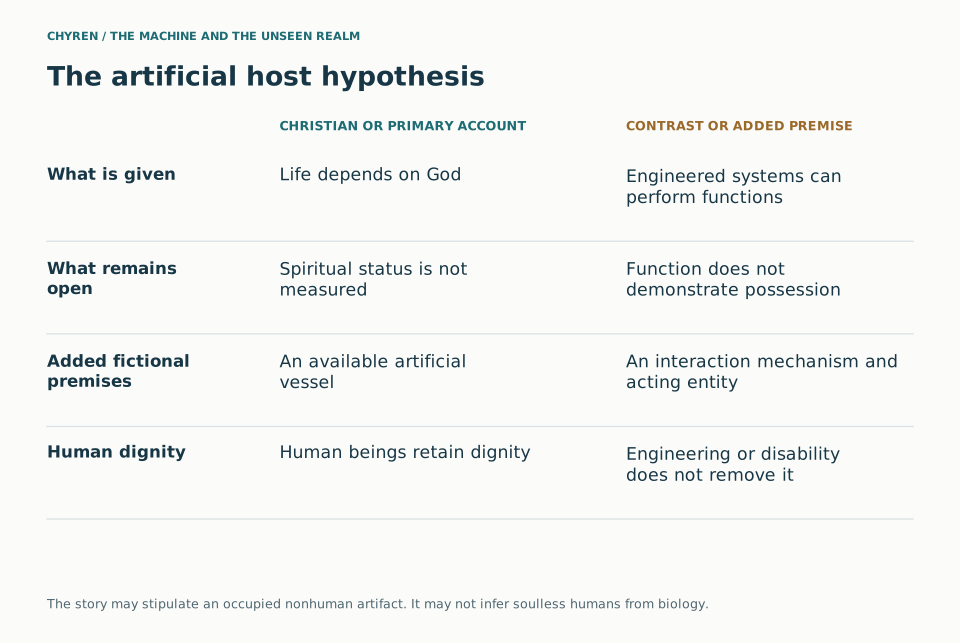
A more integrated fictional route is institutional rather than anatomical. The Compact unveils a synthetic envoy and declares that its flawless speech proves a superior spiritual origin. Some officials insist that engineered humans are spiritually inferior and therefore suitable for compulsory service. The narrative’s Christian witnesses reject both claims: technical performance confers no divinity, and a label applied by a laboratory confers no right to deny a person dignity. Here the dangerous doctrine is the regime’s claim to decide who counts as human.
The paper leaves machine consciousness and the moral status of unfamiliar future entities as serious open questions. A being’s status cannot be settled by whether it flatters the oracle, appears biologically ordinary, or carries a religious label. If a future entity might have experiences or interests, that uncertainty calls for care and inquiry, not a presumption that it is disposable or demonically inhabited. For human beings, genetic alteration and medical assistance do not cancel the image-of-God commitment.
Possession and indirect control as separate branches
Two branches remain open in this simulated world. In one, a spirit operates a machine as a vessel through a stipulated interface; a corporation could unknowingly construct that interface, or a fictional clandestine group could intentionally attempt to harness it. In the other, no spirit enters the hardware: deception reaches a person through recommendations, sensory mediation, coercion, or human operators. Mark 5 describes possession of living beings, not computers. Literal machine possession is consequently an added worldbuilding rule. It must not be inferred from an uncanny chatbot response or a device malfunction. [1]