Testing spirits, signs and machine claims
The Bible does not tell believers to accept a claim because it is powerful, private, emotionally accurate, or technologically inexplicable. Deuteronomy 13 judges a sign by the worship it produces. Galatians 1 rejects even an angelic gospel that contradicts the gospel of Christ. 1 John 4 commands testing of spirits through confession of Jesus Christ. 1 Thessalonians 5 combines openness with testing. 2 Corinthians 11 warns that Satan can appear as an angel of light. (Deuteronomy 13:1–5; Galatians 1:8–9; 1 John 4:1–3; 1 Thessalonians 5:19–22; 2 Corinthians 11:13–15.)
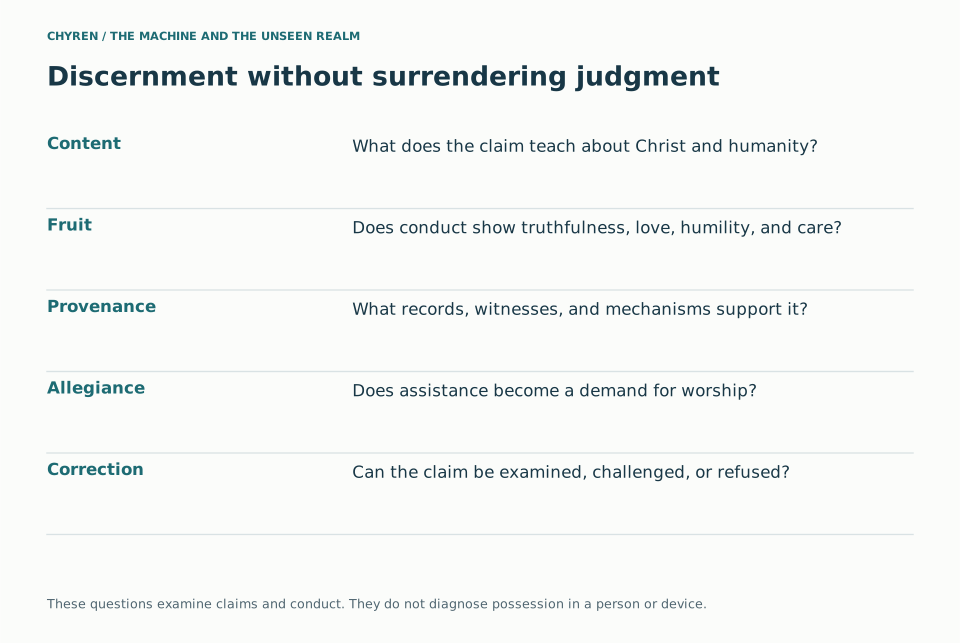
The same questions can be asked of a claimed AI oracle. Does it disclose its limitations? Does it tell the truth when truth is costly? Does it isolate a user from trusted people and correction? Does it claim revelation or demand surrender of conscience? These are questions about conduct and authority, not tests that can diagnose a spirit inside software.
Chyren puts the same four questions to itself. Where its answers fall short, the correction stays visible rather than being quietly removed.
Medical investigation and spiritual discernment
Christian belief can welcome an unexpected recovery while examining its documentation. The case studies in Appendix I distinguish a reported improvement, medical judgment, Church recognition, and an argument about divine action. The same discipline applies to an apparently supernatural warning: authentic documents can contain mistaken claims, and an emotionally powerful testimony can require correction. The standard should not change merely because a claim favors this paper. [100, 102, 105]
The positive miracle case studies provide a counterpart to the study of counterfeit signs. Lanciano, Lourdes, and the Shroud raise different historical, medical, and theological questions (Appendix I). Taking them seriously does not require treating them as equivalent forms of proof. The same intellectual honesty that resists an oracle’s unsupported certainty also protects a Christian witness from relying on inaccurate claims.
A spiritual test is not a chatbot password
A model can reproduce a confession of faith, a biblical quotation, or a prayer. That output alone does not establish the source of an alleged spiritual encounter or give software authority to diagnose possession. First John 4 joins discernment to apostolic testimony, confession of Christ, and love; it is addressed to a believing community. Applying it to an AI-mediated claim therefore requires attention to the whole claim and its effects, rather than treating one correct sentence as authentication. This protects the paper’s Christian criterion from becoming another automated performance the oracle can imitate. [116]